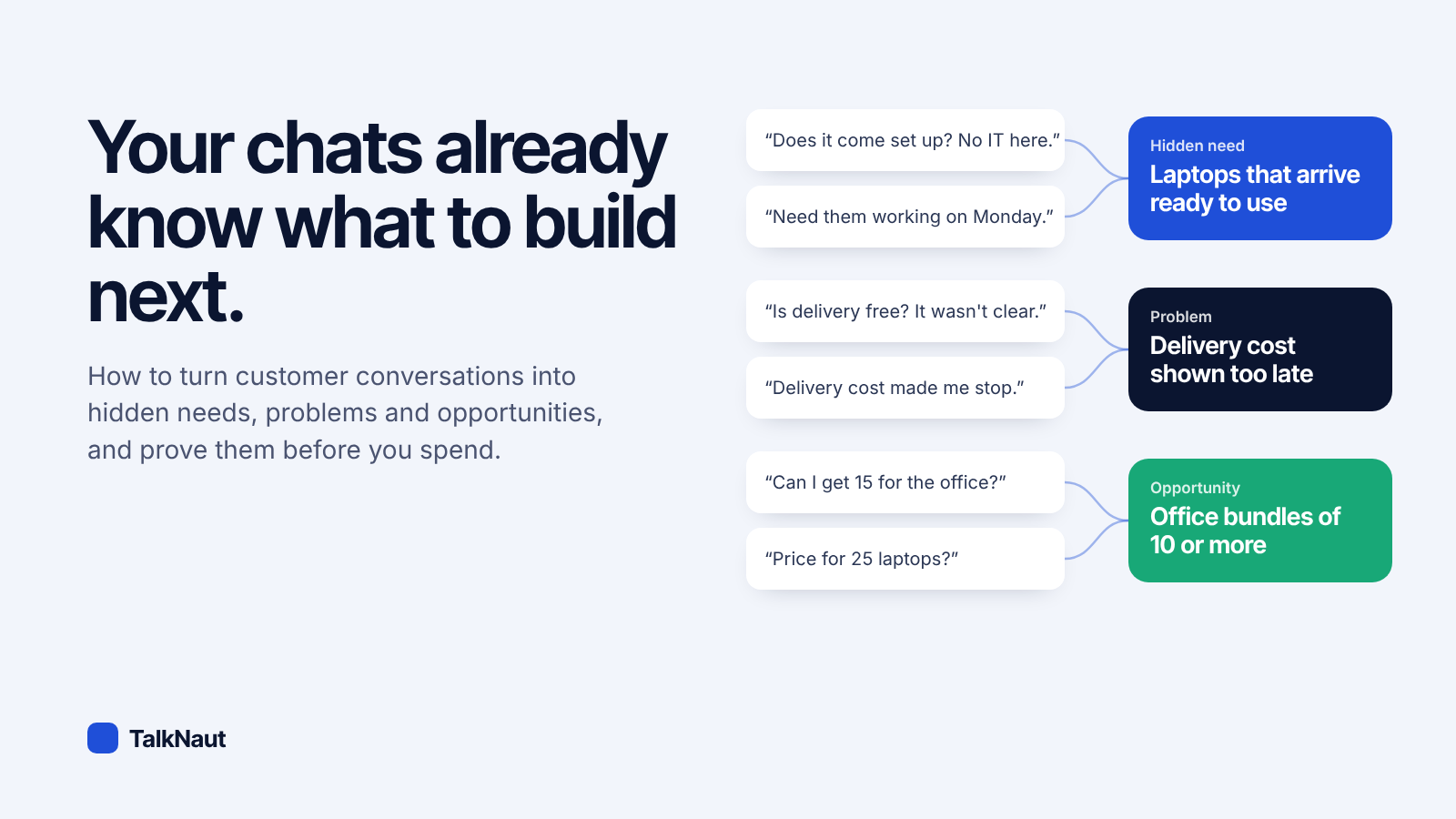
In short: customer conversations are unprompted, honest product research. Collect every chat, ticket and survey answer in one place, group the messages that mean the same thing, name each group as a need, problem, requirement or opportunity with evidence, then prove the important ones with one short survey before you build anything. TalkNaut does this automatically, like a product manager reading every conversation.
Why chats beat most research
Surveys and interviews ask people what you want to know. Chats show you what they actually care about, in their own words, at the moment they are deciding to buy or to leave. The catch is volume: nobody can read thousands of messages and keep the patterns in their head. That's where an AI that reads every conversation helps.
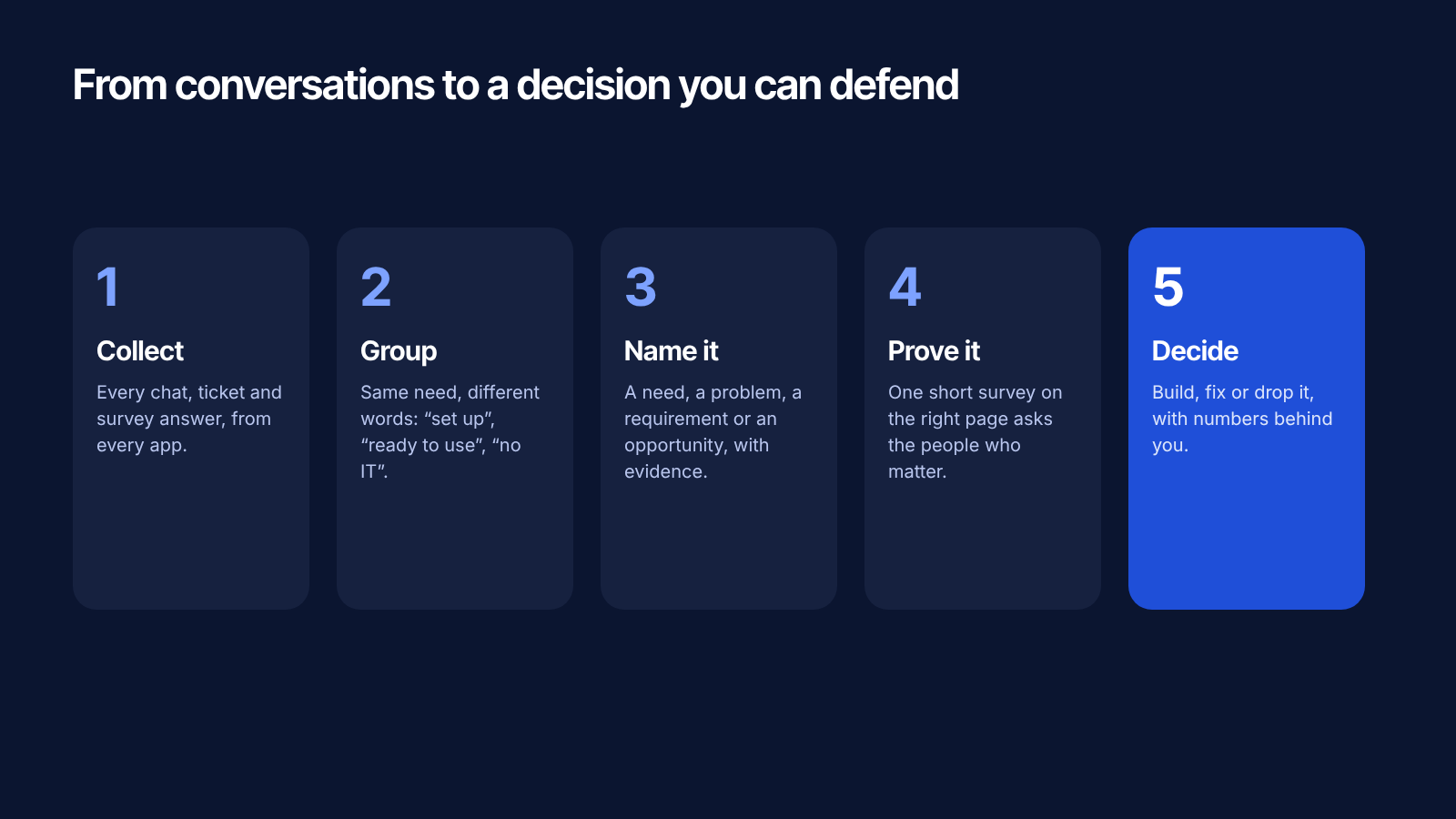
Step 1: collect everything in one place
WhatsApp, Instagram, website chat, marketplace messages, support tickets and survey answers. If they live in different apps, the patterns stay invisible. One inbox for all of them is the foundation.
Step 2: group messages that mean the same thing
Customers never use your words. "Does it come set up?", "we don't have IT" and "need them working on Monday" are three ways of saying the same thing. Grouping by meaning, not keywords, is the step that turns noise into a signal.
Step 3: name it, with evidence
Give every group a type, because each type leads to a different action:
- Hidden need: what customers want but don't ask for directly. Example: laptops that arrive ready to use.
- Problem: something that stops or annoys them. Example: delivery cost shown only at checkout.
- Requirement: a condition they must have to buy. Example: an invoice with the company's tax number.
- Opportunity: money left on the table. Example: offices asking for 10 or more units at once.
Always keep the evidence next to it: how many conversations, from which channels, with a few real quotes. A finding without evidence is an opinion.
Step 4: prove the big ones before you act
Patterns in chats are strong hints, not proof. Before you change prices, build a bundle or hire for a new service, ask the people who matter one short question on the right page. For example, on the business laptops page: "Would you pay AED 150 more per laptop for setup before delivery?" Fifty answers are usually enough to decide.
Step 5: decide, and close the loop
Build it, fix it or drop it. Then watch the same conversations: if the problem was real and the fix worked, the messages about it should become rarer, and the agents can answer the new questions from day one.
What this looks like in TalkNaut
Your agents answer on every app. In the background, the Insights page reads every conversation, ticket and survey answer and shows a short report: the hidden needs, problems, requirements and opportunities, each with evidence and quotes. For the important ones it suggests a ready-made survey, shows it on the right pages, and tells you when the answers confirm or reject the idea.
Frequently asked questions
What is an AI product manager?
Software that reads your customer conversations the way a product manager would: it finds recurring needs and problems, ranks them by how often and how strongly they come up, and suggests what to do next, including how to test an idea before investing in it.
How many conversations do I need for useful insights?
Patterns usually start to show after a few dozen conversations on the same topic. With fewer, treat findings as questions to ask, and use a short survey to check them.
Is this the same as sentiment analysis?
No. Sentiment tells you whether people are happy or upset. Product research tells you why, and what to change. Both are useful, but only the second leads directly to a decision.
Do customers need to fill in long surveys?
No. One question, shown to the right visitors at the right moment, is usually enough to confirm or reject a finding.
See what your own customers are telling you: start a free trial and connect one app.